11 Jul 2008
· media
Most major social networking sites require their users to be at least 13 years old. Anyone who has kids knows that the kids are all over Facebook, MySpace and Orkut. Of course the kids fake it, because they want the ‘social networking’, but don’t have anywhere else to go. And we know that they are at a place they shouldn’t be, and most of us can offer no alternatives…
To create a safe social networking platform for kids eight to 13 requires some doing. I have done the thinking – it makes imminent sense for Pitarato do such a thing – and put it on hold…
Continue reading →29 May 2008
· media
It’s part of my job as the editor of an industry-specific magazine to visit corporate websites in search of company information, contacts, and images. Some companies are large multinational conglomerates with head offices in Europe or the USA; others are much smaller entrepreneurial efforts trying to leverage visibility for their company through the web.
All, without exception, fail to cater to that harried journalist rushing to meet deadlines, and in search of a company logo, or image that can go with a story or feature. Most companies also fail to utilize the power of the web in being everywhere, all the time. Sure, some have a “Press Releases” or “Media” section, with a couple of stories at least six months old. But almost none have high resolution images that can be used with a story. End result, on tight deadlines, the story is squeezed into a tiny newsbrief, even though it could have been taken across a short two-column spread if there had just been some pictures to go with it.
Continue reading →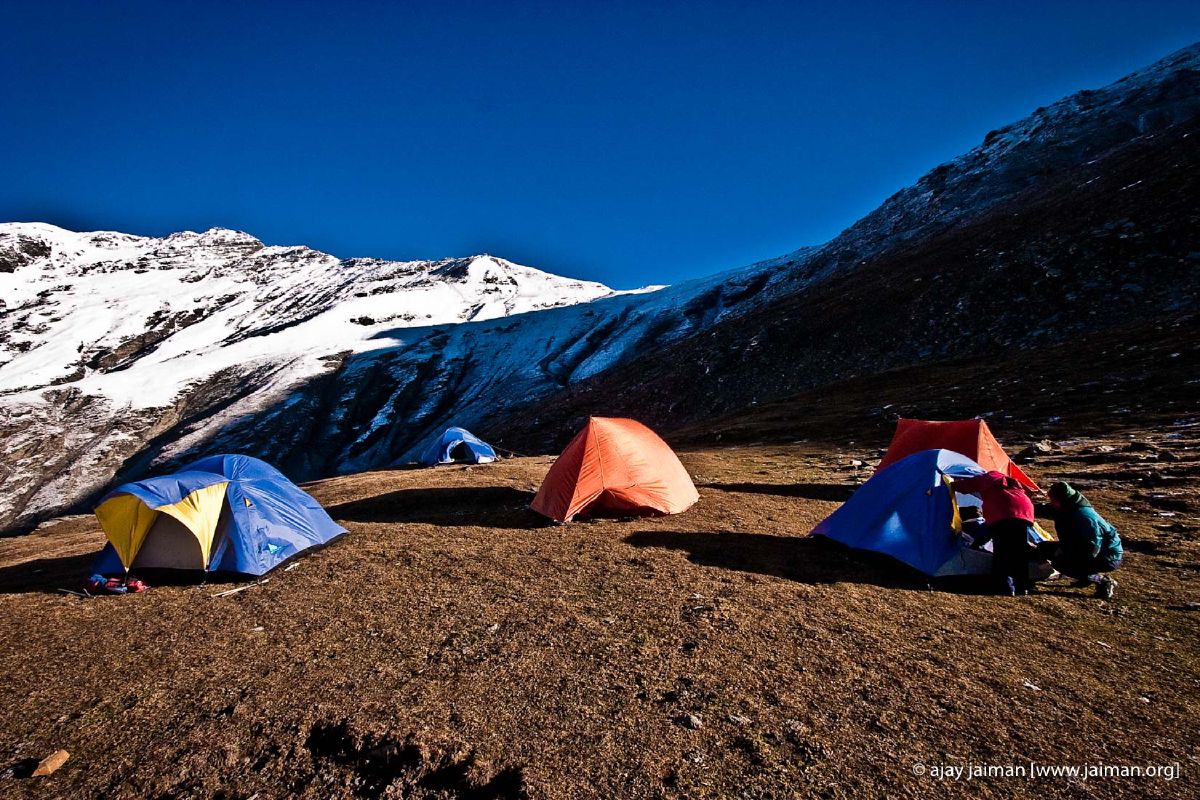
17 May 2008
· adventures
Freezing temperatures, mutinous children and kindergarten values
Educational consultant Ajay Jaiman, 40, trekked to Chandratal over the Dussehra break last year with three other families—the Bhattacharyas, the Chopras and the Chakrabartis—ranging in age from 7 to 51. Despite a recent heart attack, which has postponed a high-altitude lake expedition this summer, he has not given up on physically demanding outdoor breaks
Click on any image to view an enlarged image gallery
Continue reading →29 Nov 2007
· comment
Ethical Traveler has created a list of 13 tips that focus on travelers creating a positive impact by “by being open, informed, and willing to immerse themselves in other cultures”. A couple of them that I really like (the entire list is available here) :
Take the time to learn basic courtesy phrases : learn how to say “please” & “thank you” in the local language Remember the economic realities of your new currency : A US Dollar is worth 40 times an Indian rupee and a Euro is worth 70. A Rupee is couple of cents! Bargain Fairly : Especially in the third world. If the street vendor is selling you a handcrafted item for Rs 400, remember it is al of $10. For less than an hour’s parking in New York, you can get a chauffeur driven taxi for an entire day. Have a heart give the woman/man a tip! Understand and respect differences : You don’t have to agree with the local traditions and cultural practices but you can be respectful towards ‘strange’ cultures. Yours may be strange to them too! Be sensitive towards local social, political and environmental issues. Related Links:
Guidelines for Ethical Travel
Tips for responsible travelers
Continue reading →23 Nov 2007
· comment
From Ahmadabad to Baghdad, from Bosnia to Calcutta, from Darfur to…. there is far too much warfare, crime, hatred and genocide than I would like. Steven Pinker, however has another take on this.
“ In a preview of his next book, Steven Pinker takes on violence… Pinker charts a history of violence from Biblical times through the present, and says modern society has a little less to feel guilty about.”
Continue reading →23 Nov 2007
· comment
Research suggests that most clear hard plastic (your baby’s bottle, the bottles in the refrigerator, the sippers, the food jars on the kitchen shelf) contain a chemical called bisphenol A (BPA), which is at the minimum toxic, but perhaps even carcinogenic (can cause some forms of cancer).
The Telegraph of UK explains what BPA is:
BPA is a synthetic version of oestrogen, the female sex hormone, and experts have suggested for more than a decade that chemicals in the environment and in consumer products may be contributing to male and female diseases, such as prostate and breast cancer.
Continue reading →29 Sep 2007
· comment
The list of the worlds worst polluted place, compiled by the Blacksmith Institute is called the Dirty Thirty. The top ten ‘dishonors’ are shared by India (2), China (2), Russia (2), Azerbaijan(1), Peru (1), Ukraine (1), Zambia (1).
Click on the name below to read a profile of the place at the Blacksmith Institute website.
Sumgayit, Azerbaijan Linfen, China Tianying, China Sukinda, India Vapi, India La Oroya, Peru Dzerzhinsk, Russia Norilsk, Russia Chernobyl, Ukraine Kabwe, Zambia See all these places on the map
See pictures of some of these places
Continue reading →13 Sep 2007
· comment
Talking of networks and ‘network effects’, Duncan J. Watts professor of sociology at Columbia University and the author of “Six Degrees: The Science of a Connected Age”, has written a very interesting piece in New York Times on why the business of ‘cultural’ is so unpredictable. He shows how the power of social influence is not just limited to ‘cultural’ products like music (visit his MusicLab project), but also to technologies, consumer products… perhaps anything where people have a choice and where these people are part of a society. What does that leave?
Continue reading →12 Sep 2007
· media
I just noticed (accidentally) that I am ‘connected to’ Barack Obama, US Senator and Presidential Candidate through three different people. Talk of six-degrees of separation! In the world networked through LinkedIn, Plaxo and others, my guess is that it may not be six any more.
BTW: If you haven’t been to Plaxo recently you should check out their new interface and tools.
Continue reading →03 Sep 2007
· media
I came very close to participating in a scam executed by an India ‘social networking’ site. Unwittingly, of course! It started when I received a mail from a site called yaari.com:
‘xyd wants you to join Yaari!… Is xyz your friend?… Please respond or xyz might think you said no’
Normally I completely ignore such messages, but this time I did not. Why? Firstly, I was curious (media has been giving some play to this site), and the curiosity was heightened by the fact that the company is named as Yaari LLC, and provides an Atlanta address on the invite. Then of course, I was curious what my good friend was doing on a site like this, perhaps there is more there than apparent from the name.
Continue reading →